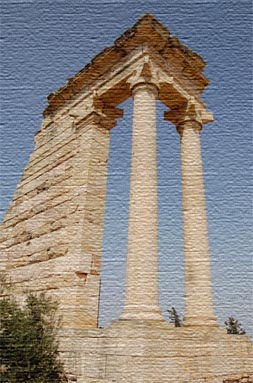
 Ancient classical columns of great archeological importance can be found in high seismicity areas in Eastern Mediterranean, such as Greece, Turkey, Italy, and Cyprus. Such multi-drum columns are constructed of stone blocks that lie on top of each other usually without connecting material in between.
Furthermore, the understanding of the behavior and response of these structures during strong earthquakes is useful for the assessment of conservation and rehabilitation proposals for such structures, while it may also reveal some information about past earthquakes in the region.
The investigation of the seismic behavior of ancient columns is scientifically interesting, as it involves complex rocking and sliding phenomena of the individual rock blocks.
Analytical study of such multi-block structures under strong earthquake excitations is practically impossible due to their highly nonlinear behavior. Furthermore, laboratory tests and large-scale experiments for such structures demand prohibitively expensive equipment and facilities, which are not generally available, especially in Cyprus. Consequently, it is necessary to use numerical methods to simulate the dynamic behavior and seismic response of these structures.
The discrete element method (DEM) is a set of numerical techniques that have been specifically developed for the simulation of systems of multiple independent bodies that can move relatively freely in space while interacting with each other through contact forces.
This method can be utilized in the study of ancient columns and colonnades during strong earthquakes by simulating the individual rocks blocks in the same way as they are actually built, as distinct bodies. Research work using the DEM to simulate ancient monuments has already been conducted with good results, but there is plenty of room for improvements and further utilization of this method.
We are currently working on the development of a DEM-based software application specifically oriented towards performing efficient seismic simulations of multiblock structures.
The developed program enables the investigation and understanding of the influence and effect of the different characteristics of earthquake excitations as well as the various mechanical and geometrical characteristics of these structures on their seismic response.
Furthermore, the addition of proper elements to model seismic isolators in the developed software application will enable the investigation of the effectiveness of potential usage of seismic isolation in ancient columns and colonnades. Seismic isolation has been proposed as a passive control measure for the protection of ancient monuments from strong earthquake actions. Therefore, the ability to numerically assess the performance of seismic isolation on these structures will be particularly useful and interesting.
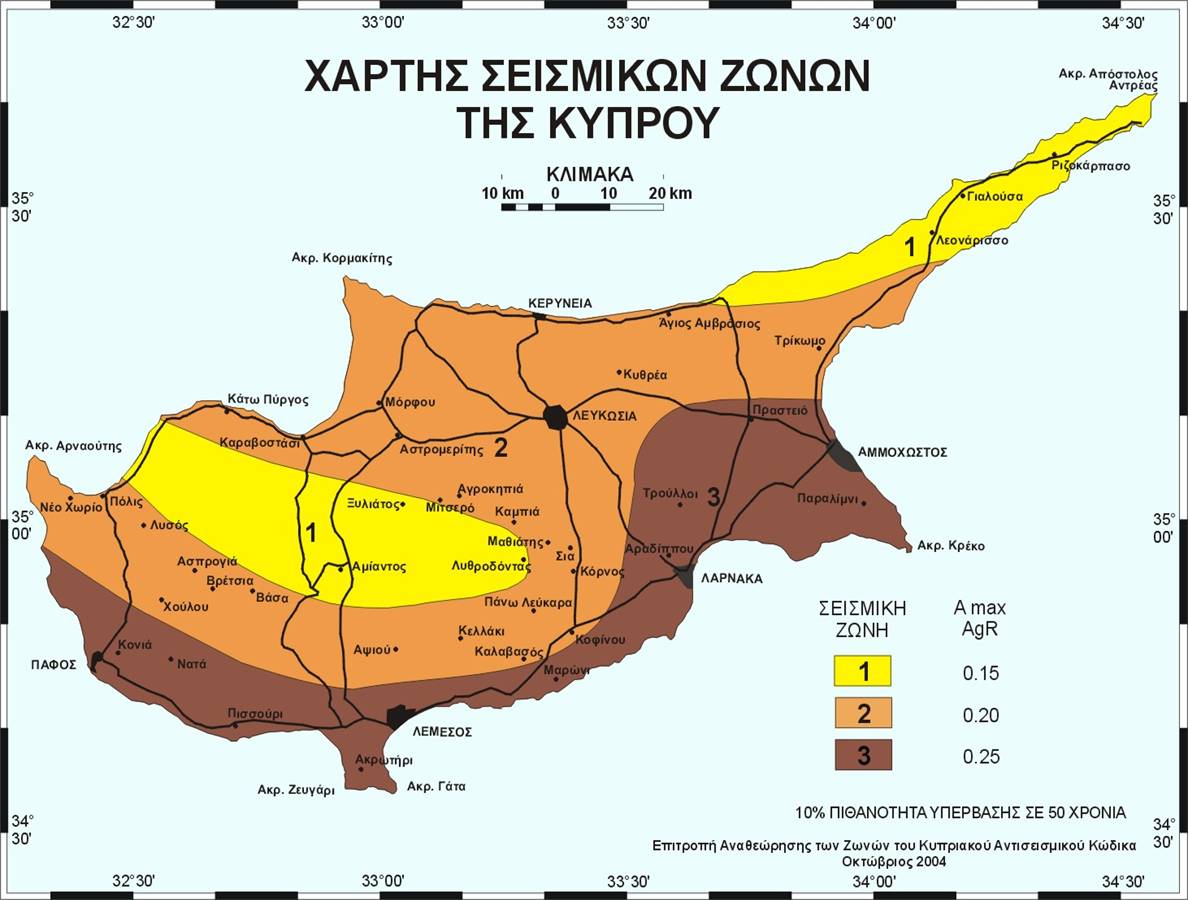
Cyprus is situated within the second intensive seismic zone of the earth, that of the Alpine-Himalayan belt. This zone extends from the Atlantic Ocean along the Mediterranean basin through Italy, Greece, Turkey, Iran and India to the Pacific Ocean. The earthquakes occurring in this zone represent about 15% of the world seismic activity.
The very active construction development in Cyprus, in combination with the very limited land in the city centers, lead to the practice that follow the rest of the European countries, where buildings are constructed very close to each other.